

Healthy Paranoia in the Fake Society
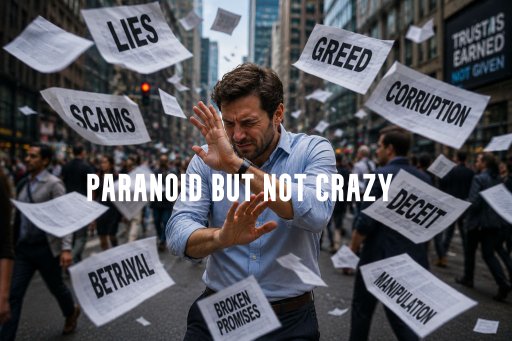
(Image by Bernard Starr; desiigned by Starr with ChatGPT AI) Details DMCA
Remember the old quip: It was so cold outside yesterday that politicians had their hands in their own pockets. That was the "good old days." Today, the joke has lost its edge. It no longer feels like a joke. Across much of modern life-- politics, business, media-- there seem to be no conditions severe enough to stop institutions from reaching into your pockets
There was a time when saying, "Everywhere I turn, people and companies are out to screw me," would raise concerns about paranoia. It reasonably would have suggested a mindset in need of treatment. Today, that same instinct may be closer to rationalism than pathology.
We now live in a fake society-- a landscape saturated with distortion, manipulation, corruption, and performance masquerading as truth. Fake has blossomed so pervasively that it has become normalized. In this shift, a large degree of suspicion--healthy paranoia--is not only rational, but smart and necessary. The sooner you grasp this new "reality" the sooner you will be on a path of sanity and survival as you navigate the treacherous fake society.
The Fake Landscape
From a growing list of 25 dimensions of the fake society, here are four for openers:
Fake PoliticiansConsider this: many Americans struggle to pass the same basic civics test required of immigrants seeking citizenship. As many as 1 in 3 Americans can't according to a national survey by citizens and scholars.com. Yet we routinely entrust governance to individuals who often demonstrate only a superficial grasp of those very principles.
There was a time when voters sought leaders who were more informed, more thoughtful, and more capable than themselves.
Few who elected Franklin D. Roosevelt with landslide victories for president because he seemed like someone they'd be comfortable chatting with at a backyard barbecue. They supported him because he embodied competence and leadership.
Today, the trend appears to have reversed. Many voters gravitate toward figures who mirror their own frustrations, biases, and informational blind spots. In this climate, beliefs are frequently treated as equivalent to facts, especially when reinforced by echo chambers on social media.
It's striking that more than two millennia after Greek philosopher Aristotle articulated the foundations of logic and reasoning, those principles are rarely applied, revealing that they remain widely unknown.
Fake Leaders (Constituency Careerists)
The term "Fake Leaders" applies not only to an increasing number of political figures but also to leaders across various fields who rise not through educational or professional achievement but through what can be called constituency careerism.
These individuals discover early that they possess charisma: a talent for attracting attention, followers, and loyalty. Instead of developing real expertise or making meaningful contributions in traditional arenas, they focus on building audiences that finance their comfortable-- sometimes extravagant-- constituency careers. Their stances are not grounded in principles but shaped by whatever resonates most powerfully with their supporters.
As their base grows, so does the incentive to amplify outrage, oversimplify complex issues, and adopt increasingly extreme positions. Over time, some transform from mere influencers into de facto cult leaders, eventually stepping into political candidacies and gurus in other sectors such a finance, life coaching, and spirituality.
Their defining trait is adaptability, not to truth, but to the demands of their audience. Like chameleons, they constantly shift positions to keep the applause and loyalty coming.
(Note: You can view every article as one long page if you sign up as an Advocate Member, or higher).