


 Would you like to know how many people have visited this page? Or how reputable the author is? Simply
sign up for a Advocate premium membership and you'll automatically see this data on every article. Plus a lot more, too.
Would you like to know how many people have visited this page? Or how reputable the author is? Simply
sign up for a Advocate premium membership and you'll automatically see this data on every article. Plus a lot more, too.
 SHARE 
|
|





Inventor: Method and apparatus for load balancing trapped solar energy OTEC Counter-Current Heat Transfer System Global Warming Mitigation Method Subductive Waste Disposal Method Nuclear Assisted Hydrocarbon Production Method
OpEdNews Member for 839 week(s) and 1 day(s)
15 Articles, 0 Quick Links, 32 Comments, 0 Diaries, 0 Polls
Articles Listed By Date
List By Popularity
List By Popularity

(1 comments) SHARE
Friday, January 23, 2026
Twelve Hiroshima Bombs Per Second Last year, the oceans absorbed heat equivalent to twelve Hiroshima bombs exploding every second. No blast, no headlines--just energy silently stored in seawater. Climate change is no longer just an emissions problem. It is a heat-accumulation problem, already written into the oceans, shaping sea levels, storms, food systems, and global security for centuries to come.
Friday, January 23, 2026Twelve Hiroshima Bombs Per Second Last year, the oceans absorbed heat equivalent to twelve Hiroshima bombs exploding every second. No blast, no headlines--just energy silently stored in seawater. Climate change is no longer just an emissions problem. It is a heat-accumulation problem, already written into the oceans, shaping sea levels, storms, food systems, and global security for centuries to come.

(1 comments) SHARE
Sunday, December 14, 2025
The Thermodynamic Reckoning For more than a century, physicists have warned that the laws governing energy and heat are absolute. Einstein said they would never be overturned. Lotka and Odum showed how these laws shape everything from ecosystems to industrial economies. And yet today's climate policy behaves as if these principles are optional--or worse, irrelevant.
Sunday, December 14, 2025The Thermodynamic Reckoning For more than a century, physicists have warned that the laws governing energy and heat are absolute. Einstein said they would never be overturned. Lotka and Odum showed how these laws shape everything from ecosystems to industrial economies. And yet today's climate policy behaves as if these principles are optional--or worse, irrelevant.
(1 comments) SHARE
Tuesday, November 11, 2025
Artificial Intelligence - Real Heat My op-ed Artificial Intelligence, Real Heat explores how the energy demand and waste heat from AI systems contribute to planetary warming and how Thermodynamic Geoengineering (TG) could convert that excess heat into clean energy and climate balance. The piece reframes AI as part of the solution, not just the problem. Originally published on Substack, it's part of my ongoing series on sustainable innovation. Jim Baird
Tuesday, November 11, 2025Artificial Intelligence - Real Heat My op-ed Artificial Intelligence, Real Heat explores how the energy demand and waste heat from AI systems contribute to planetary warming and how Thermodynamic Geoengineering (TG) could convert that excess heat into clean energy and climate balance. The piece reframes AI as part of the solution, not just the problem. Originally published on Substack, it's part of my ongoing series on sustainable innovation. Jim Baird
(1 comments) SHARE
Tuesday, June 13, 2023
Global warming is a problem of thermodynamics Thermodynamic geoengineering. The solution to global warming and the global economy.
Tuesday, June 13, 2023Global warming is a problem of thermodynamics Thermodynamic geoengineering. The solution to global warming and the global economy.

(3 comments) SHARE
Sunday, November 22, 2020
The equivalent of 5 billion Hiroshimas have been added to the ocean since the signing of the test ban treaty? We need a mechanism for defusing the 5 billion Hiroshima bomb equivalents worth of heat we have added to the ocean over course of the last six decades.
Sunday, November 22, 2020The equivalent of 5 billion Hiroshimas have been added to the ocean since the signing of the test ban treaty? We need a mechanism for defusing the 5 billion Hiroshima bomb equivalents worth of heat we have added to the ocean over course of the last six decades.
(3 comments) SHARE
Monday, October 26, 2020
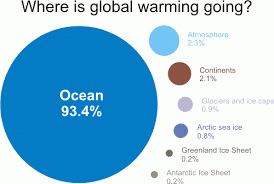
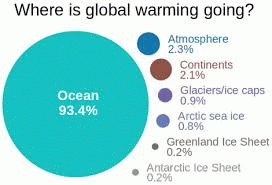
Global-warming Placebo versus the Remedy It is established science that 93 percent of the heat of global warming is going into the ocean. Less well understood is the fact that this heat will eventually come back to bite us, if not outright do us in. Even less well understood is the fact that the only way to safely remove heat from the ocean is to convert a portion of it to the work required to sustain 10 billion people who will live on the land by 2050.
Monday, October 26, 2020Global-warming Placebo versus the Remedy It is established science that 93 percent of the heat of global warming is going into the ocean. Less well understood is the fact that this heat will eventually come back to bite us, if not outright do us in. Even less well understood is the fact that the only way to safely remove heat from the ocean is to convert a portion of it to the work required to sustain 10 billion people who will live on the land by 2050.

(6 comments) SHARE
Sunday, April 26, 2020
The tech-fix that gives mankind from between 3 and 11 thousand years Thermodynamic geoengineering is that techno-fix that can sustain mankind, at at least current population levels, for a least the next three thousand years. Which is a good an answer as any to the question posed by the Jeff Gibbs in the opening frames of Michael Moore's documentary Planet of the Humans, how long do you think humans have?
Sunday, April 26, 2020The tech-fix that gives mankind from between 3 and 11 thousand years Thermodynamic geoengineering is that techno-fix that can sustain mankind, at at least current population levels, for a least the next three thousand years. Which is a good an answer as any to the question posed by the Jeff Gibbs in the opening frames of Michael Moore's documentary Planet of the Humans, how long do you think humans have?

(4 comments) SHARE
Saturday, February 2, 2019
The energy trifecta; entropy, economy, environment. The energy trifecta is energy too cheap to meter that provides the jobs and social benefits that a carbon tax, fossil fuels or energy privation can't. In short it is the only energy that makes winners of us all.
Saturday, February 2, 2019The energy trifecta; entropy, economy, environment. The energy trifecta is energy too cheap to meter that provides the jobs and social benefits that a carbon tax, fossil fuels or energy privation can't. In short it is the only energy that makes winners of us all.

(2 comments) SHARE
Tuesday, June 26, 2018
Energy legitimately too cheap to meter At $2.3 trillion less than and 39 percent more energy than is currently provided by current energy sources, it would be cheaper and less bureaucratic to simply provide energy produced by heat pipe OTEC platforms for a flat fee or even free and make a profit from the associated services, which include reduced surfaced heat loading, sea-level rise, storm surge, atmospheric CO2 and ocean acidification.
Tuesday, June 26, 2018Energy legitimately too cheap to meter At $2.3 trillion less than and 39 percent more energy than is currently provided by current energy sources, it would be cheaper and less bureaucratic to simply provide energy produced by heat pipe OTEC platforms for a flat fee or even free and make a profit from the associated services, which include reduced surfaced heat loading, sea-level rise, storm surge, atmospheric CO2 and ocean acidification.

(4 comments) SHARE
Friday, November 3, 2017
Climate mitigating energy production. The jobs, taxes and international prestige that flow from solving the climate problem are going begging
Friday, November 3, 2017Climate mitigating energy production. The jobs, taxes and international prestige that flow from solving the climate problem are going begging
(3 comments) SHARE
Saturday, May 21, 2016
Channeling the Inertia of Global Warming The energy paths confronting the next two generations couldn't be starker. A "business as usual" case that assumes 4 degrees of global warming is inevitable. An "off-the-shelf" case that uses existing technologies that will get us to between 3 and 4 degrees. And a case for lowering the ocean's heat load that lowers atmospheric temperatures 1 degree each decade. The choice we should chose seems self-evident.
Saturday, May 21, 2016Channeling the Inertia of Global Warming The energy paths confronting the next two generations couldn't be starker. A "business as usual" case that assumes 4 degrees of global warming is inevitable. An "off-the-shelf" case that uses existing technologies that will get us to between 3 and 4 degrees. And a case for lowering the ocean's heat load that lowers atmospheric temperatures 1 degree each decade. The choice we should chose seems self-evident.
(7 comments) SHARE
Wednesday, September 2, 2015
Science and politics disregard the climate lessons of Nature and mankind is failed as a consequence. Scientists have discovered, measured and explained the slowing of atmospheric warming this century and a decline in sea level rise in 2010. The practical implications of these events however seems to have escaped them; with the result policy makers are deprived of the information that would enable them to address climate change with the least cost and greatest benefit.
Wednesday, September 2, 2015Science and politics disregard the climate lessons of Nature and mankind is failed as a consequence. Scientists have discovered, measured and explained the slowing of atmospheric warming this century and a decline in sea level rise in 2010. The practical implications of these events however seems to have escaped them; with the result policy makers are deprived of the information that would enable them to address climate change with the least cost and greatest benefit.
(21 comments) SHARE
Wednesday, February 19, 2014
The Practical Implication of the Global Warming Hiatus. Global warming is arguably the most compelling problem this and future generations is likely to face. We can calmly and adequately address it by using the climate pause as a learning exercise.
Wednesday, February 19, 2014The Practical Implication of the Global Warming Hiatus. Global warming is arguably the most compelling problem this and future generations is likely to face. We can calmly and adequately address it by using the climate pause as a learning exercise.
(1 comments) SHARE
Tuesday, November 15, 2011
The Willie Sutton/Will Rogers Approach to Energy Ocean Thermal Energy Conversion (OTEC) converts accumulating ocean heat to energy and could produce renewable energy 24/7 and reduce the intensity of future hurricanes.
Tuesday, November 15, 2011The Willie Sutton/Will Rogers Approach to Energy Ocean Thermal Energy Conversion (OTEC) converts accumulating ocean heat to energy and could produce renewable energy 24/7 and reduce the intensity of future hurricanes.
(4 comments) SHARE
Friday, July 23, 2010
A change for the better The time is ripe for America to use its greatest strength, its entrepreneurial energy and ability to raise capital, to its benefit as well as the rest of the world.
Friday, July 23, 2010A change for the better The time is ripe for America to use its greatest strength, its entrepreneurial energy and ability to raise capital, to its benefit as well as the rest of the world.
