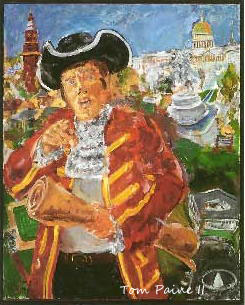


Tom Paine's famous pamphlet, Common Sense, inspired in patriots a conscription surge that saved the revolution. In the dark days of Valley Forge, George Washington required that it be read to his troops. These are among the few words that then touched and tried men's souls:
But where says some is the King of America? I'll tell you Friend, he reigns above, and doth not make havoc of mankind like the Royal Brute of Britain... [I]n America the law is King. For as in absolute governments the King is law, so in free countries the law ought to be King; and there ought to be no other.
A government of our own is our natural right: And when a man seriously reflects on the precariousness of human affairs, he will become convinced, that it is infinitely wiser and safer, to form a constitution of our own in a cool deliberate manner, while we have it in our power, than to trust such an interesting event to time and chance. If we omit it now, some, Massanello may hereafter arise, who laying hold of popular disquietudes, may collect together the desperate and discontented, and by assuming to themselves the powers of government, may sweep away the liberties of the continent like a deluge.
Also pertinent today, to underscore the fundamental constitutional stake, is Tom Paine's next pamphlet, The American Crisis, which begins as follows:
THESE are the times that try men's souls. The summer soldier and the sunshine patriot will, in this crisis, shrink from the service of their country; but he that stands by it now, deserves the love and thanks of man and woman. Tyranny, like hell, is not easily conquered; yet we have this consolation with us, that the harder the conflict, the more glorious the triumph. What we obtain too cheap, we esteem too lightly: it is dearness only that gives every thing its value.