

LIBERAL DEMOCRACY AT THE END OF ITS ROPE PART II
(Image by Socialist Planning Beyond Capitalism) Details DMCA
Author, Bruce Lerro, Co-Founder and Co-Organizer of Socialist Planning Beyond Capitalism
Orientation
Unfortunately, in the United States the terms "liberal, "democracy" and "capitalism" are all mushed together according to the following logic:
- All democratic societies are liberal;
- All liberal societies are capitalist and
- All democratic societies are capitalist
In Part I of my article, I challenged this logic because many capitalist societies have dictatorships and some socialist societies are democratic. Part I was divided into two parts. The first half is about the shortcomings of representational democracy in its ontological ground in Newtonian and epistemological foundations in Descartes. I also discussed how representational liberalism cannot be democracy because it conceives of wholes as either mechanical aggregates where the whole is no more than the sum of individuals. The other kind of whole is a mystical whole which has no individuality. This mystical whole, called "unitary democracy", is the subject of the second half of Part I. At the end of Part I the author Benjamin Barber describes how liberal representational democracy consciously or unconsciously supports authoritarian unitary democracy which can turn into mobs. At the end of Part I I posed some questions which set up participatory, thick politics as moving beyond both representational and unitary democracy.
I What is Thick Participatory Politics?
According to Benjamin Barber in his book Strong Democracy, politics is a very special activity which differentiates us from the rest of the animal kingdom with the known exception of chimps, crows, ravens and dolphins all of whom have a rich social life. All human activity is not political. For example, where there is consensus there is no conflict, power struggle or the need for political reasonableness. At the other extreme, in human society if there is no common agreement there is no ground for politics.
There are four conditions for politics which I'll list and then go into detail about:
- Necessity of public action (as opposed to voluntary);
- Choosing means and ends between actual evils that are distinguished only by degree (rather than between an ideal good and an ideal evil);
- In the presence of conflict (vs harmony) and
- In primordial interdependency
Let us go over each of these. By "necessity" Barber means actions enmeshed in events that are part of a train of cause and effect already at work in the world and will continue in their motion unless there are contrary inputs from conscious political actors. Non-actors bear responsibility for whatever results their non-decisions have allowed. By "action" Barber means doing (or not doing), making (or not making) something in the physical world that limits human behavior, changes the environment or affects the world in some material way. Where there is no action (or non-action of consequence) there is no politics.
Choosing means deciding on ends and means through a process of collective deliberation, weighing the pros and cons, deciding, making a plan, taking action and monitoring the results. Action that is impulsive or arbitrary is not yet political action in terms of thick democracy. The rabble is not an electorate and a mob is not a citizenry.
The search is for solutions that are less than arbitrary even though they cannot be true or certain. Liberal representation of abstract rationale based on a pre-political natural right is not realistic. Rather, a reasonable choice will be practical rather than metaphysical and it will be without force or coercion. It makes preferences and opinions earn legitimacy by forcing them to run the gauntlet of public deliberation and public judgment.
Political processes for thick participatory democracy are not about bargaining and horse-trading in which individual preferences are accepted as given as they are for representative liberalism. The collective process in participatory democracy of having to think for the whole corrects, opens up and transforms narrow preferences as it widens them. Barber gives the analogy of the difference between liberal democracy's voting compared to citizens' participation.
Barber writes that voting is like a group of people in a cafeteria bargaining about what they can buy as a group that will suit their individual tastes. Voting in the bargaining model often fixes choices and thereby stultifies the imagination. Liberal representational democracy treats individual opinions as given and conflict is simply a bargaining process by which individuals come to the table to choose among options. Those with the most votes are the winners and others give their consent. Thick democratic politics is like a group of people in a cafeteria contriving new means, inventing new recipes and experimenting with new diets in the effort of creating a public taste that they can all share and that will supersede the conflicting private tastes about which they once tried to strike bargains.
Thick participatory democracy resists the liberal idea that conflict is intractable and at best vulnerable only to adjudication among lawyers or toleration. Instead, it develops a politics that can transform conflict into cooperation. It is the creative dialectical struggle of conflict which creates an expanded cooperation.
If there is political truth it can only be the kind of truth that is made in the course of the doing. Barber declares that politics is like a rag-and-bone shop of the practical and the concrete - the everyday and the ambiguous, the malleable and the evanescent. Politics can be grimy with the muddled activity of reluctant doers who must nonetheless do the best they can. It is dark, confused and tumultuous with many bends, angels and elbows.
To say that a society is too complex to manage through direct democracy ignores the technological means of communication which already exist like the electronic communications systems of multinational corporations and international banks. These networks incorporate, however unconsciously, millions of workers in dozens of countries. The communal imagination is like a rubber balloon. The initial stretching is the hardest, but after that it stretches with increasing ease. See table at Socialist Planning Beyond Capitalism
Brian Barry lists seven models of decision-making in his book Political Argument:
- Decision by combat
- Bargaining
- Discussion on merits
- Voting
- Deciding by chance
- Deciding by voting
- Authoritarian determination
- Political talk
Pragmatic ancient republicans generally understood intelligence as a property of communities rather than of individuals. Charles Sanders Peirce contends that the back and forth of me and you dissolves in a form of talk possible only for human beings, no other animal . The art of conversation is the art of finding language that is broad and novel enough to bring out conflicting perceptions of the world yet sufficiently genuine to withstand the later objections and wear and tear of the subscribing parties. Political dialogue is not about expressing affection or building friendships. In fact, the attachments we feel toward natural kith and kin can be constricting and parochializing.
One measure of healthy political talk is the amount of silence it permits. Barber says silence is the precious medium in which reflection is nurtured. "I will listen" does not mean "I will scan my adversary's position for weaknesses and potential trade-offs". Neither does it mean "I will tolerantly permit my opposition to say whatever they choose". It means I will try to put myself in their place. I will strain to hear what makes us alike. I will listen for a common rhetoric evocative of common purpose. As a result of our common talk, we create alternative future consequences and then ones more provisional and concrete. Political talk is not talk about the world which makes dialogue too passive. Political discussions are talks that shape and reshape a world that is in the process of becoming.
Agenda Setting
In thin democracies, agendas are typically regarded as the province of elites - political committees or executive officers. In thick democracies decision-making can be vital democratic processes. However, who controls the agenda - even over only its wording may not determine the outcome, but they control it. The ordering of the alternatives can affect the patters of choice as decisively as their formulation. If we reserve talk and its evolution to specialists - to journalists, managers, clerics or social scientists - then no amount of equality will yield democracy.
Thick democratic talk places its agenda at the center rather than at the beginning of its politics. Agenda setting as an ongoing function involving the persistent reconceptualization of public business, of the very idea of the public. Thick democratic decision-making is based on judgment rather than preference. Our preferences are merely contemplative or speculative until we make them subjects of our wills and transform them into actions. With preferences we ask, "Do you prefer A, B or C?". With wills we ask "what sort of world do you will our common world to be?
Political Will - Deliberation vs Voting
Liberal representative democrats commonly assume that democracy means democratic choice with voting as the essence of choice. The reduction of democracy to voting implies that a ready-made agenda exists when none has been agreed on. This deliberative process lends itself neither to quantification nor representation. "Majority wins" is a tribute to the failureof democracy: to our inability to create a politics of mutualism that can overcome private interests. A weak and complacent majority can unthinkingly overrule an impassioned and well-argued minority.
III The Limitations of Thin Democratic "Preferences"
The first liberal representative to collective decision-making is that there so many different preferences there would be overload. Liberal democrats say If we take people's right to preferences as given it would be impossible to coordinate and rank them all with a finite agenda. But Barber comments that intransitivity is a problem in liberal democracy because it suggests preferences are incommensurable, like individual atoms.
However, Barber says in part the problem is because preferences have been grown and seeded in the dark cellars of isolation. Of course, if you bring these preferences to the light of the agora they will be at first blinded and then disoriented. But once the individual preferences get their bearing, and come to the communal gathering, they will find their place or misplace together with others. Those preferences which are half-baked, immature and pathological will be exposed and those which are inspiring will acquire a following. Discussion enables us to examine the rank orders and the effect of time and place.
Preferences are connected to voting. Voting freezes us into rational dilemmas. Those who believe that democracy is like a Pythagorean puzzle that becomes invalid if it cannot be solved by the theorems of logic and statistics mixed up with problems of numbers and worlds that are unnecessary to confront. Thick participatory citizenship is more than the expression of preferences and the pulling of levers. Voters are equal in the number of votes they cast but may be widely unequal in the intensity of their understanding of an issue. A minority of people who are committed to something intensive are a qualitative minority who can persuade those who feel more moderately or apathetic about a political issue.
Thin democratic voting and preferences obstruct communal talk in two ways:
- Through representation they make it impossible for losers and dissenters to voice their postelection regrets in a public place where it will be heard. As a consequence, disappointed participants are often transformed into voiceless aliens.
- Liberal institutions slight the witness functions of talk in presuming that views should be aired only before the decision is make and such self-expression has no rational function afterwards.
IV Thin Democracy Lacks Rituals
Lastly, voting has no rituals as accompaniments of celebration. In the United States Barber writes that voting is like going to a public toilet. In his book The Death of Communal Liberty he writes that the Swiss still choose their representative and vote in day-long assemblies in which festive games, theatre and drinking accompany the formal voting process. Founding myths and the rituals associate with them such as Bastille Day in France or August 1st in Switzerland. Representative political heroes can supplement political talk through the imagination reconstruction of the past in live images.
V So Where Does Participatory Democracy Apply?
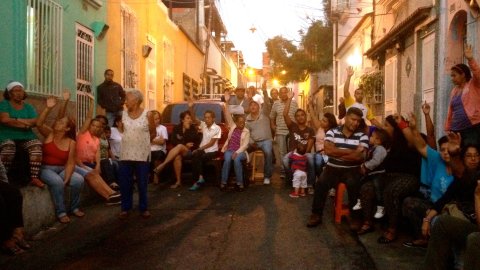
In his book Strong Democracy, Benjamin Barber does not talk about socialism. However participatory democracy is alive and well in the history of workers' councils during the Paris Commune and the Russian and Spanish revolutions in the first half of the 20th century. It is present in the communal councils in Venezuela in present time as well as in workers' cooperatives all over the world. Participatory democracy is the natural micro-unit of state socialist societies linking up with mesoregions and macro life of state planning by socialist parties, each influencing and being influenced in a dialectical manner.
See table which compares the three kinds of democracy: Click Here