
The Switzerland Talks: A Pragmatic Turn in U.S.-Iran Relations and the Challenge of Regional Spoilers
History often advances through dramatic events such as wars, revolutions, and military confrontations. Yet some of the most consequential turning points occur quietly, around negotiating tables far from the battlefield. The recent negotiations between the United States and Iran in Switzerland may ultimately prove to be one of those moments. While much attention has focused on the military aspects of the 2026 Iran War, the more important story may be the emergence of a diplomatic process that neither side appeared willing to consider only months earlier.
The talks held at the Burgenstock resort overlooking Lake Lucerne represented the first sustained direct
negotiations between senior American and Iranian officials since the outbreak of the conflict. They occurred within the framework of the Memorandum of Understanding signed earlier in the year, which established a sixty-day period for negotiating a more comprehensive settlement. The negotiations were facilitated by Pakistan and Qatar, both of which played important mediating roles throughout the crisis. Reports from multiple sources indicate that the discussions lasted approximately eighteen hours and produced a roadmap for continued technical negotiations. Although many difficult issues remain unresolved, the talks established mechanisms for communication and crisis management that did not exist before.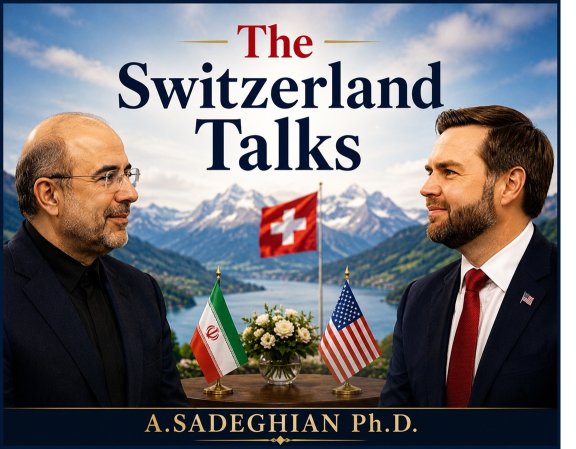
One of the most interesting aspects of the negotiations was the composition of the delegations. The American side was led by Vice President JD Vance, supported by special envoys Steve Witkoff and Jared Kushner. The Iranian delegation was led not by the foreign minister alone but by Mohammad Bagher Ghalibaf, the Speaker of the Iranian Parliament and one of the most influential political figures in contemporary Iran. This choice was significant. Ghalibaf is often viewed as a pragmatic conservative who possesses credibility both within the security establishment and among more technocratic factions of the political system. His presence signaled that Tehran was treating the negotiations as a strategic undertaking rather than a merely diplomatic exercise.
Ghalibaf role deserves particular attention. Throughout his career, he has developed a reputation as a manager and problem solver rather than as an ideological firebrand. His background as a military commander, police chief, mayor of Tehran, and parliamentary speaker has given him extensive experience navigating competing centers of power. By placing Ghalibaf at the forefront of the negotiations, Iran appeared to be communicating that it was prepared to pursue a practical rather than symbolic process. Whether one agrees with his politics or not, the choice suggested that Tehran sought an agreement capable of surviving domestic political scrutiny.
Vice President JD Vance played an equally important role on the American side. During the talks he repeatedly emphasized that the United States was prepared to pursue what he described as a fundamental transformation in relations with Iran if sufficient guarantees could be achieved regarding regional security and nuclear oversight. His public statements following the negotiations suggested cautious optimism. He described the talks as establishing a strong foundation for a final agreement while acknowledging that major obstacles remained. Unlike many previous episodes of U.S.-Iran diplomacy, the negotiations were not framed exclusively around nuclear issues. They also addressed the reopening of the Strait of Hormuz, mechanisms for avoiding military incidents, and stabilization efforts in Lebanon.
President Donald Trump occupied a more complicated position. On one hand, the negotiations would not have occurred without his decision to authorize them. The Memorandum of Understanding itself emerged from recognition that continued military escalation carried enormous costs for both sides. On the other hand, Trump's public comments frequently created uncertainty. Reports indicate that some of his statements nearly caused the Iranian delegation to suspend participation altogether. This reflects a recurring feature of Trump's political style. He often combines diplomatic outreach with public threats and rhetorical pressure. Supporters view this approach as strategic leverage. Critics view it as unnecessary volatility. Regardless of one's interpretation, it became clear during the Switzerland talks that successful diplomacy required negotiators to manage not only substantive disagreements but also the political consequences of public messaging.
The immediate benefits for the United States were substantial. First, the talks produced mechanisms intended to keep the Strait of Hormuz open. Given that a significant portion of the world's energy supplies transit through this waterway, even modest reductions in risk have major economic implications. Second, the negotiations created a pathway for renewed international nuclear inspections. Third, they reduced the likelihood of direct military confrontation between American and Iranian forces. Fourth, they offered Washington an opportunity to stabilize a region that had become increasingly volatile and expensive to manage. From a purely strategic perspective, diplomacy offered outcomes that military action alone could not achieve.
Iran also secured important benefits. The United States granted sanctions waivers affecting Iranian oil exports, providing much-needed economic breathing room. Discussions regarding access to frozen assets and reconstruction assistance created the possibility of economic recovery after a costly conflict. Equally important, Iran achieved these gains without formally surrendering its core claims regarding sovereignty or national dignity. For a political system that places enormous value on resistance to external pressure, that distinction matters. Iranian leaders can present the negotiations domestically not as capitulation but as pragmatic engagement undertaken from a position of resilience.
No discussion of the negotiations would be complete without considering Israel's position. Prime Minister Benjamin Netanyahu has long viewed any significant U.S.-Iran rapprochement with skepticism. His strategic outlook has been shaped by the belief that Iran represents a long-term threat that cannot be neutralized through diplomacy alone. Consequently, any agreement that normalizes relations between Washington and Tehran potentially reduces Israel's influence over American Middle East policy. This does not necessarily mean that Israel opposes peace. It does mean that Israeli leaders may evaluate diplomatic success through a different strategic lens than American policymakers.
The days surrounding the Switzerland talks demonstrated how fragile the process remains. Renewed violence in Lebanon and other regional flashpoints repeatedly threatened to derail negotiations. Several planned meetings were delayed or canceled amid escalating military activity. Whether these events were intentional attempts to sabotage diplomacy or simply manifestations of broader regional instability remains a matter of debate. What is clear is that every outbreak of violence strengthened opponents of compromise on all sides.
The broader significance of the Switzerland negotiations lies not in what they immediately achieved but in what they made possible. For the first time since the war began, both sides moved beyond crisis management toward a structured diplomatic process. Communication channels were established. Technical negotiations were initiated. Limited confidence-building measures were implemented. None of these developments guarantee success. Yet they represent a departure from the assumption that military force alone could determine the future relationship between Iran and the United States.
Diplomacy succeeds when political leaders conclude that the costs of continued confrontation exceed the risks of compromise. The Switzerland talks suggest that such a calculation may finally be emerging in both Tehran and Washington. Whether that realization can survive domestic political pressures, regional rivalries, and decades of mutual distrust remains uncertain. Nevertheless, the negotiations have already demonstrated something important: even after war, diplomacy remains possible.
The real question is no longer whether the United States and Iran can talk to one another. The question is whether they can build enough trust to transform a temporary ceasefire into durable peace. The answer to that question will shape not only the future of U.S.-Iran relations but the future of the Middle East itself.
Suggested References
- Reuters, "Vance says Iran has agreed to allow nuclear inspectors," June 22, 2026.
- Reuters, "14-point draft U.S.-Iran deal sent to Congress," June 17, 2026.
- Axios, "U.S. and Iran launch direct negotiations in Switzerland," June 20, 2026.
- Axios, "Trump's messy path to peace," June 22, 2026.
- Axios, "Iran to allow UN inspectors back in, Vance says," June 22, 2026.
- Associated Press, "Vance says talks set good foundation for permanent deal," June 22, 2026.
- Al Jazeera, "US, Iran agree on roadmap towards final deal in Switzerland talks," June 22, 2026.
- The Guardian, "US-Iran talks laid very good foundation for successful final deal," June 22, 2026.
- The Guardian, "US-Iran talks abruptly called off after Israel and Hezbollah trade attacks," June 19, 2026.
- Reuters reporting on Strait of Hormuz mechanisms and technical talks, June 22, 2026.
- Background on the Islamabad Memorandum and negotiating process.
- Background on the 2025-2026 U.S.-Iran negotiations.
 1
1
 1
1
 1
1